“`html
Introduction
Conversations about cannabis often resemble sports analysis: teams, reputations, and tactics. The labels Indica, Sativa, and Ruderalis carry assumptions, but the reality is a blend of genetic and biochemical nuances.
This piece treats these labels like teams: highlighting strengths, weaknesses, and the role of hybrid genetic ratios in outcomes. Our goal isn’t to romanticize strains but to quantify what’s important for growers, breeders, and users.
Analysis of teams
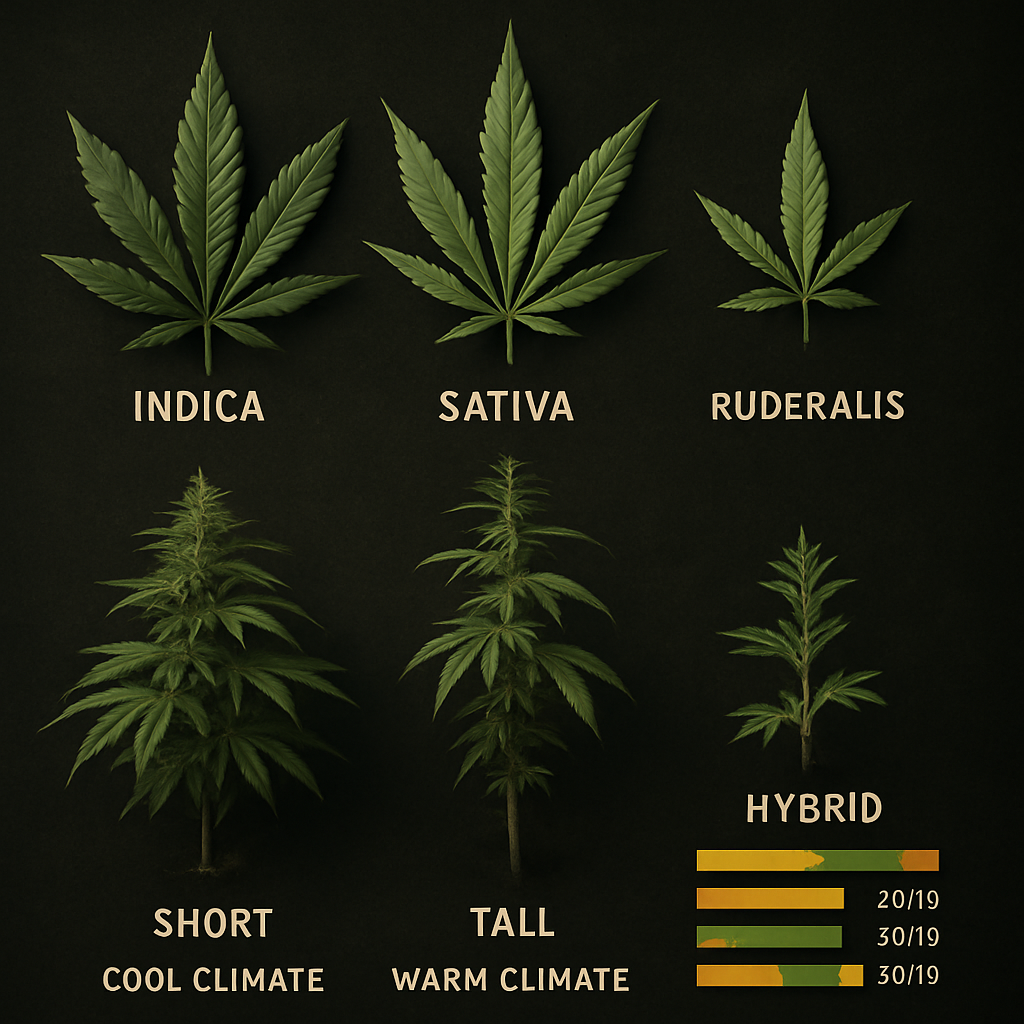
Indica characteristics vs Sativa traits are often discussed in terms of growth patterns and effects. Indica is known as a defensive, compact team with shorter plants, dense buds, and sedative effects. Sativa is seen as the offensive team with taller plants, airy flowers, and stimulating highs, often reducing discussions to Indica vs. Sativa traits. Despite these traditional views, it’s crucial to delve deeper into the spectrum of Indica characteristics vs Sativa traits to understand their real-world implications.
Ruderalis acts as the utility player: small, resilient, and quick to flower. Its modern role focuses on characteristics like autoflowering and environmental resilience rather than potency. Understanding Ruderalis markers and uses can aid breeders in enhancing these traits.
Hybrids combine desirable traits and minimize weaknesses. Understanding hybrid genetic ratios explained can help elucidate why two plants with the same name can behave differently under identical conditions. This variability further complicates the dialogue surrounding Indica characteristics vs Sativa, making clear, data-driven discussions vital.
Key factors
Genotype is inherited strategy, while phenotype is execution. Differences in chemotype and phenotype are crucial: chemotype defines cannabinoid and terpene composition, and phenotype reveals growth and shape. These chemotype and phenotype differences are key to real-world outcomes. Thus, when discussing Indica characteristics vs Sativa, one must consider these biochemical and environmental interactions as pivotal influences.
Labels like Indica or Sativa often refer to plant shape or expected effects, not strictly to genetics. This raises discussions of genetic lineage vs marketed labels, as decades of hybridization have blurred lines, creating tension between genetics and expectations. As these lines blur, the importance of understanding Indica characteristics vs Sativa becomes increasingly apparent.
THC and CBD levels matter, but terpene profiles shape experiences more than THC alone. Terpenes can alter and define the effects, making plants with similar THC levels feel different, adding layers to the Indica characteristics vs Sativa conversation.
Ruderalis crosses introduce autoflowering traits, removing light-cycle sensitivity. This is valued for faster growth cycles, making Ruderalis genetics common in commercial and home-bred varieties.
Breeding strategy affects hybrid traits. A 50/50 cross might show diverse traits, while backcrossing stabilizes them; hybrid ratios guide breeders in describing expected traits and outcomes. Such strategies are deeply tied to achieving desired Indica characteristics vs Sativa outcomes in the plants chosen.
Scenario match
Scenario A: A label promises classic Indica effects, but genetic testing shows Sativa heritage with limonene-dominated terpene profile. Indica characteristics vs Sativa in marketed labels can mislead; it’s the chemotype and phenotype that reveal true characteristics. This scenario highlights the critical nature of understanding Indica characteristics vs Sativa distinctions beyond labels.
Scenario B: A breeder needs a fast-growing cultivar for multiple annual harvests and selects Ruderalis for its autoflowering traits. Potency may be improved later by backcrossing with high-THC varieties.
Scenario C: A medical program seeks consistent CBD:THC ratios, focusing on chemotype over morphology, selecting CBD-heavy variants, and stabilizing through breeding. Genetic lineage vs. market labels becomes less important than lab-confirmed profiles.
Scenario D: A hybrid marketed as 70% Sativa, 30% Indica is more about parentage than guaranteed effects. Hybrid genetic ratios explained suggest how the dominant parent influences plant structure and terpene profile, but diverse outcomes can occur due to varying phenotypes.
Practically, expect variation. Even within inbred lines, conditions like environment, nutrients, and light affect phenotype expression, making cultivation conditions as crucial as genetic makeup.
Practical implications for growers and users
Growers should prioritize lab reports and stable cultivars over vague Indica/Sativa labels. Indica characteristics vs Sativa debate might help with planning, but chemotype and phenotype influence market value and consumer response. By focusing on Indica characteristics vs Sativa factors, growers can better cater to specific market demands or personal preferences.
Consumers and clinicians should seek cannabinoid and terpene analyses rather than rely on traditional or marketing stories, reducing effect variability and enhancing predictability.
Breeders should be clear about hybrid genetic ratios explained and goals. Detailed genetic and trait-targeting information allows users to make informed choices suited to their needs. Such clarity aids in navigating the complexities of Indica characteristics vs Sativa, ensuring expectations align with genetic reality.
Limitations and future directions
Genetic testing has improved but isn’t widespread. Legacy names linger without updated lineage, posing a cautionary tale about trusting marketed labels.
Advancements in chemotype mapping and phenotype imaging will enhance predictability. As data grows, correlations between terpene profiles and subjective effects will strengthen, shifting focus from anecdotes to data. These innovations will further illuminate the ongoing debate of Indica characteristics vs Sativa.
Regulation and standardization will increasingly separate marketing claims from measurable traits, leading to fewer surprises for consumers and clearer objectives for breeders.
Conclusion
The Indica/Sativa dichotomy is just the beginning. Indica characteristics vs Sativa captures physical traits and expectations, but biochemistry tells the full story. Effective analysis involves understanding both genes and chemotypes, then observing how phenotypes react in real growing conditions. Indica characteristics vs Sativa discussions must evolve past simplistic views to embrace these scientific insights.
Ruderalis has redefined modern breeding by adding autoflowering resilience, while knowing hybrid genetic ratios empowers breeders to predict outcomes. By focusing on chemotype and phenotype, and staying skeptical of labels without pedigree, growers, clinicians, and consumers will achieve the best results. Navigating the landscape of Indica characteristics vs Sativa with knowledge and caution ensures success in this ever-evolving field.
“`